State Open School Boards Admission | 85% Delhi State Quota Benefits
Secure a legal dummy admission in Delhi or flying admission in Delhi through recognized state open school boards like BBOSE, UPSOSB, and RSOS. Act as a non attending school in Delhi to optimize your entrance prep hours and confidently unlock the 85% Delhi state quota in NEET and the powerful Delhi state quota benefit in JEE.
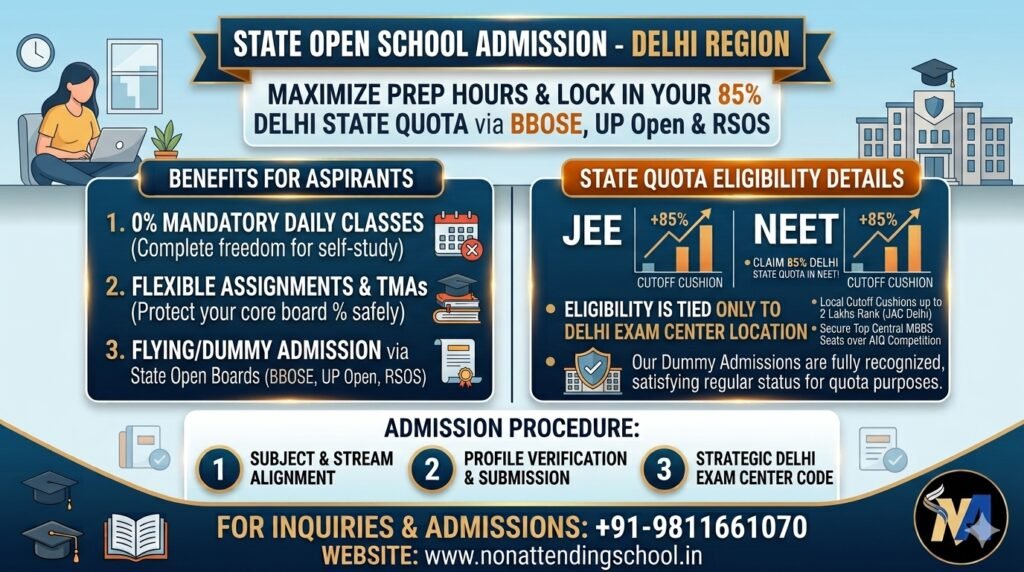
The Definitive Guide to State Open School Boards: Leveraging BBOSE, UPSOSB, and RSOS to Unlock the 85% State Quota in JEE & NEET
For engineering and medical aspirants aiming to clear premier national entrances like JEE Main and NEET-UG , time management is the thin line between success and failure. Navigating a standard schooling routine demands 13 to 14 hours every single day when combined with intense coaching schedules. This leaving students physically exhausted, mentally drained, and completely starved of crucial self-study windows, concept revision, and rigorous mock test practice.
To break away from these academic bottlenecks, strategic students utilize flexible pathways like the National Institute of Open Schooling (NIOS) or recognized State Open School Boards . By establishing a legal dummy admission in Delhi or a rapid flying admission in Delhi through an open board’s designated regional center framework, aspirants can focus completely on their preparation while locking in game-changing systemic privileges like the legendary 85% state quota of Delhi .
This comprehensive guide details the core working module of top State Open Boards—including BBOSE, UP Open, and Rajasthan Open—and explains the step-by-step procedure to leverage them as a highly protective non attending school in Delhi to beat out-of-state competition comfortably.
What is a State Open School Board? The Core Working Module
State Open School Boards are autonomous educational systems established directly under the legislative framework of their respective provincial state ministries of education. Operating with equivalent statutory status as traditional state secondary boards, their passing credentials, marks cards, and certifications are fully recognized by COBSE (Council of Boards of School Education in India), making them valid for all premium engineering, medical, and central university counseling systems nationwide.
Unlike standard regular boards that tie students to physical benches, the operational module of a State Open Board relies on absolute educational flexibility:
- Zero Attendance Directives: Daily physical attendance requirements are 0%, letting students study full-time at home or within competitive coaching hubs.
- Continuous Internal Credit Security: Open boards implement simple, home-prepared internal assessments or assignment modules that protect a student’s core percentage without routine academic interference.
- Public and On-Demand Exam Tracking: Exams are typically hosted twice a year, while advanced frameworks include modular testing options to clear subjects at a highly customized pace.
Overview of Major State Open Boards
Different regions feature specialized state-run open formats designed around academic flexibility:
1. BBOSE (Bihar Board of Open Schooling and Examination)
BBOSE stands as a major state open schooling body in eastern India. It offers highly structured streams for Senior Secondary (Class XII) examinations, operating with full recognition for competitive students seeking credit clearance or fresh stream registration. For aspirants coordinating their coaching tracks out of centers like Patna, it acts as a reliable framework to stabilize academic timelines smoothly.
2. UP Open (Uttar Pradesh State Open School Board – UPSOSB)
UPSOSB caters to the largest student footprint in the northern belt. It operates with highly accessible stream formatting and features an expansive network of local study centers. It is widely utilized by competitive aspirants who need to detach from routine classroom demands while maintaining fully recognized senior secondary board validation.
3. Raj Open (Rajasthan State Open School – RSOS)
Operating directly out of Jaipur, RSOS is deeply integrated alongside major competitive coaching ecosystems like Kota. RSOS is custom-engineered to accommodate students balancing intense, high-octane engineering and medical modules, providing seamless registration structures that minimize administrative friction for local or out-of-state test-takers.
The Strategic Link: The Mechanics of National Seat Allotment
To understand why matching a State Open Board tracking layout with a local regional center is so powerful, you must trace how institutional seats are distributed across India during technical and medical admissions.
The Technical B.Tech Matrix (JAC Delhi Counseling)
During Joint Entrance Examination (JEE) admissions, seats are split into national All India Pools and localized Home State Quotas. Central state universities in the national capital—such as Delhi Technological University (DTU) , Netaji Subhas University of Technology (NSUT) , and IIIT-Delhi —reserve a massive 85% of their total branch matrices exclusively for candidates from the local region.
The eligibility metric is precise: it ignores your native birthplace or permanent domicile records. It tracks exclusively the physical address of the examination center where you physically appeared for and passed your Class XII board papers. If your final state open passing certificate records a verified exam center operating within the local regional borders, you satisfy the baseline rule to claim the Delhi state 85% quota in JEE .
The Medical MBBS Matrix (MCC & IPU Counseling)
For medical aspirants clearing NEET-UG, seat allocation follows a parallel legislative formula:
- 15% All India Quota (AIQ): A highly dense nationwide open list where a single mark variation shifts ranks by thousands, requiring flawless scores.
- 85% State Quota Pool: The vast majority of seats inside top-tier state government medical colleges are set aside for local region candidates. Routing your open school documentation through a local regional center activates your access to the Delhi state quota in NEET .
Why the Delhi State Quota Delivers a Dramatic Advantage
The national capital hosts an exceptional density of top-ranked central government educational institutions in India. Because of this concentration, local region students enjoy a massive protective cushion that dramatically drops competitive cutoffs.
1. The Engineering Shield: DTU & NSUT Cutoff Cushions
Claiming a seat at DTU or NSUT via the All India open pool leaves zero room for error, demandingly restricting out-of-state rankings. However, invoking your Delhi quota in JEE totally alters the competitive equation.
Because competition is locked exclusively to candidates passing through local board parameters, cutoffs extend deep into the rankings. Thanks to the comprehensive Delhi state quota benefit in JEE , local candidates can comfortably secure coveted government engineering placements even with national ranks extending up to 2 lakhs within specific categories.
2. The Medical Shield: Premium Government MBBS Access
Delhi medical colleges—including Maulana Azad Medical College (MAMC) and Vardhman Mahavir Medical College (VMMC) —are the gold standard due to their outstanding clinical caseloads and low fee parameters.
Chasing these seats under the 15% AIQ pool requires near-flawless performance. However, securing your open school registration footprint via a regional center in the capital opens up the 85% Delhi state quota in NEET . This powerful delhi quota in NEET completely bypasses out-of-state competition. The resulting Delhi state quota benefit in NEET drops minimum entry thresholds significantly, allowing local students to secure top-tier central medical seats at scores that would fail out-of-state requirements.
Step-by-Step State Open School Admission Procedure
To successfully leverage a state open board as a verified non-attending structure that accesses local state advantages, your registration timeline must follow a precise, professionally managed framework handled by expert partners like Apex Education.
Step 1: Regional Center Mapping
When executing your open school application files, out-of-state students must strategically associate their profile with an Accredited Study Center or set their physical examination venue code directly inside a verified regional center. This technical configuration ensures your final passing documentation carries the localized source code required to establish local status during counseling phases.
Step 2: Documents Verification & Upload
Aspirants must submit fully authenticated copies of their foundational academic records:
- Original Class X Marksheet and Passing Certificate.
- School Leaving Certificate (SLC) or Transfer Certificate (TC).
- Recent passport-size color photographs and clear digital signature files.
- Valid Government Identity Proof (such as an Aadhaar Card).
Step 3: Stream and Subject Coordination
Candidates must select their academic groups carefully to maintain full compliance with the strict rules set by national engineering and medical counseling directories:
- Engineering Group: Physics, Chemistry, Mathematics, English, and one high-scoring elective.
- Medical Group: Physics, Chemistry, Biology, English, and one elective subject.
Step 4: Academic Execution and Practical Testing
While daily attendance requirements are waived, the coordinating network keeps you synchronized with mandatory internal submission windows. During the final public examination schedules, you will travel to your designated center to complete your board practical finals and written theory testing safely.
Core Structural Breakdown
| System Parameter | Standard regular Schooling Layout | State Open School Layout (With Local Center) |
|---|---|---|
| Attendance Demands | Strict 75% physical attendance required | 0% Physical Presence Required |
| Daily Commuting Loss | 6 to 8 hours lost daily in school routines | Zero time lost; entire day dedicated to study |
| Syllabus Execution | Restricted to basic board homework | Fully customizable for JEE / NEET modules |
| Home Quota Access | Locked to your native board location | Grants clear access to the 85% Delhi State Quota |
| DTU / NSUT Cutoffs | Extremely high for All India pool ranks | Significantly relaxed cutoffs up to 2 Lakhs rank |
| Internal Assessment Work | Demanding physical file submissions | Simple, flexible continuous assignment logs |
Frequently Asked Questions (Q&A)
Q1: Are passing certificates from BBOSE, UPSOSB, and RSOS valid for national entrance counseling?
A: Yes. These state open boards are autonomous bodies established by their respective provincial governments and recognized by COBSE. Counseling directories like JoSAA, JAC Delhi, and the Medical Counselling Committee (MCC) fully accept their marks cards on equal legal ground with central boards like CBSE.
Q2: How does an open school profile secure the 85% state quota of Delhi?
A: Local home state quota eligibility is determined strictly by the physical location of the exam center where you sat for your final Class XII board papers. By using an authorized network to map your open board registration to a center code within the local territory, your credentials satisfy the core requirement needed to invoke local privileges during counseling.
Q3: Why is choosing a non attending school in Delhi format highly beneficial for JEE and NEET aspirants?
A: Forcing a student to attend both regular school classes and competitive coaching programs demands an exhausting 13 to 14 hour routine daily, eliminating personal revision windows. An open board or non-attending structure waives daily physical classes entirely, giving you a continuous daytime window focused purely on mock exams and core concept mastery.
Q4: What rank advantages does the Delhi state quota benefit in JEE deliver at universities like DTU?
A: While out-of-state candidates face razor-thin cutoff lines under the All India open pool, local applicants enjoy massive rank protection. The local Delhi state quota benefit in JEE enables regional candidates to comfortably secure top engineering branches at DTU or NSUT even with national ranks extending deep into the tens of thousands, and up to 2 lakhs rank within specific category parameters.
Q5: Can a student claim the 85% Delhi state quota in NEET if their permanent home is in another state?
A: Yes. Counseling directories specify that state institutional quota allocation tracks the physical address code of your qualifying senior secondary board center, not your family’s birthplace or permanent domicile records. Enrolling your open board papers through a local center safely fulfills this tracking rule.
Q6: How are board practical final exams handled under a state open board framework?
A: Your coordinating study center manages your practical timeline transparently. The open board organizes short, structured practical orientation sessions right before the final examination windows, letting you secure competitive practical scores without disrupting your daily entrance preparation routine.
Q7: How can I connect with an authorized partner to process my dummy admission in Delhi securely?
A: You can consult with processing experts like Apex Education directly. Reach out via their main regional corporate center at A-12, 2nd Floor, Vikaspuri, New Delhi (Above City X-Ray, near Metro Pillar 632), or initiate an admission review instantly by calling or messaging +91-9811661070 .