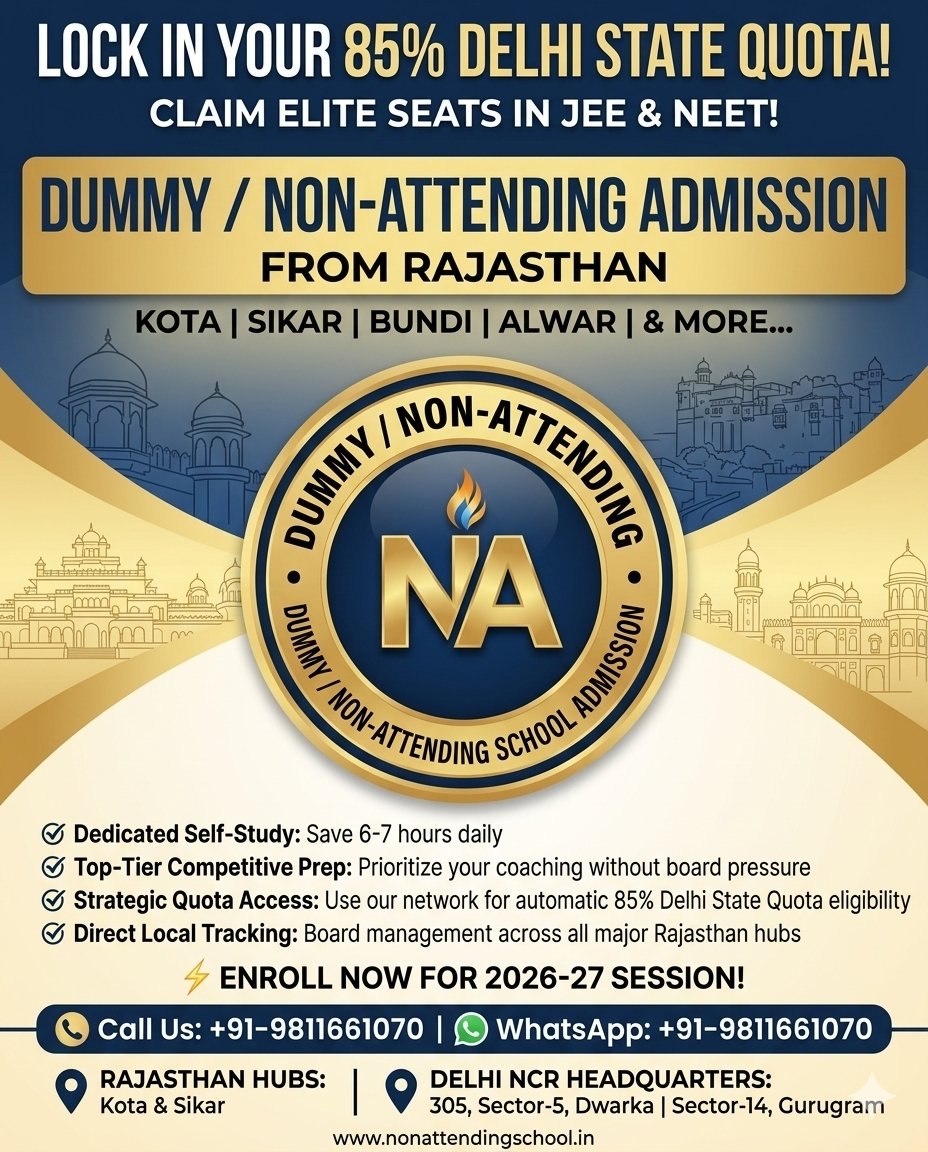
Dummy School Admission in Kota, Sikar, Bundi | Delhi Quota Advantage
Admissions open for Class VI to XII (Science, Commerce, Arts) in Kota, Sikar & Bundi. Join our premium dummy|non attending school network from Delhi to claim the 85% state quota in JEE and NEET while preparing in Rajasthan.

Admission in Rajasthan: Kota, Sikar, Bundi, and Beyond
Welcome to the definitive Admission Portal for Rajasthan at nonattendingschool.in . As India’s premier educational support network, we facilitate structured regular schooling pathways alongside highly flexible board enrollment options. For thousands of intense engineering and medical aspirants stationed across Rajasthan’s massive coaching hubs—including Kota, Sikar, and Bundi —balancing daily school attendance with competitive exam preparation is a major roadblock.
If you are currently evaluating a Dummy school from Kota (Rajasthan) or searching for an accredited framework that frees up your self-study hours, our platform provides legal, fully compliant admission channels. By integrating your academic registration with our network, you can maintain your primary coaching base in Rajasthan while unlocking structural institutional reservations in the national capital region. This guide outlines our comprehensive curriculum frameworks from Class VI to XII across the Science, Commerce, and Humanities streams, while detailing how to make your academic path highly competitive.
1. The Strategy: Balancing Rajasthan Coaching with School Boards
Rajasthan is the undisputed national capital for competitive exam preparation. Cities like Kota, Sikar, and Bundi attract hundreds of thousands of determined students every year targeting top percentiles in JEE Main, JEE Advanced, and NEET-UG. However, the standard academic routine often places a severe strain on a student’s daily schedule:
    THE EXHAUSTION GAP IN TRADITIONAL ROUTINES
+-------------------------------------------------------------+
| Traditional Regular Schooling Pathway:                      |
| [School: 6-7 Hours] + [Coaching: 4-5 Hours] + [Travel: 1 Hr]|
| = 12-13 Hours of Class. Result: Zero time for Self-Study.   |
+-------------------------------------------------------------+
| Flexible Non-Attending Pathway via Our Network:             |
| [Coaching: 4-5 Hours] + [Dedicated Revision: 7-8 Hours]     |
| = Balanced Schedule. Result: Optimized Exam Performance.    |
+-------------------------------------------------------------+
As highlighted by top educational mentors, revision, consistent practice, and mock testing are the absolute keys to cracking national selection exams. When a student spends 13 to 14 hours every single day simply sitting through lectures across both a regular school and a coaching center, their energy is completely exhausted.
To resolve this issue, our network provides direct access to optimized, flexible board registrations through verified Non attending schools in India . This approach ensures you remain legally registered with accredited boards, eliminates daily non-academic tasks (like minor project works or mandatory physical presence checks), and gives you full control over your daylight hours for exam preparation.
2. Unlocking the 85% Delhi State Quota from Rajasthan
The most powerful tactical advantage we provide to students preparing in Kota, Sikar, or Bundi is the ability to claim high-value institutional reservation advantages in New Delhi. Many families preparing in Rajasthan assume they are restricted to their native state’s reservation percentages. However, under current centralized admission guidelines, eligibility for regional state reservation quotas is determined solely by the geographical location of the school where the candidate clears their Class XI and Class XII board examinations , completely independent of their native home domicile or parental land holdings.
By working with our admissions grid to enroll in an accredited non attending school in Delhi or a Flying school in Delhi , a student can live and attend coaching in Kota or Sikar while remaining registered under a capital-region institution. This automatically qualifies them for the coveted 85% state quota in Delhi upon graduation.
Understanding the Seat Pool Mechanics
If you are wondering how to get 85% delhi state quota in JEE and NEET , the process is entirely legal, compliant, and highly structured. We manage your formal board enrollments through a registered Dummy school in Delhi . This simple administrative shift fundamentally alters your long-term admission odds:
- Engineering Aspirants: You can Secure your B. Tech government seat through 85% delhi state quota at elite technical universities like Delhi Technological University (DTU) and Netaji Subhas University of Technology (NSUT). Under the 85% Delhi quota in JEE main , historical cutoffs show that regional quota candidates secure core engineering branches at ranks that would be safely out of bounds under the general All India pool.
- Medical Aspirants: You can secure your MBBS government seat through 85% delhi state quota at top-tier institutions, including Maulana Azad Medical College (MAMC) and Vardhman Mahavir Medical College (VMMC). Utilizing the 85% state quota in NEET moves you out of the hyper-competitive national pool into a far more accessible regional candidate list.
Learning exactly how 85% Delhi state quota availed metrics operate allows students to leverage their academic registration to gain a major competitive advantage, bypassing the extreme cutoffs of the open All India Quota (AIQ) allocations. This strategic option is equally valuable for local students or those shifting from a traditional non attending school from Bihar .
3. Academic Details: Middle School (Classes VI to VIII)
Our Middle School program builds strong logical thinking, deep analytical skills, and comprehensive conceptual tracking. This curriculum framework remains identical for both our full-time regular schools and our flexible learning tracks.
Mathematics
- Core Arithmetic & Calculations: In-depth studies of the real number system, integers, fractions, decimals, rational properties, exponents, square roots, and cube roots.
- Commercial Math: Practical problem-solving involving ratios, proportions, percentages, profit and loss calculations, and simple/compound interest formulas.
- Algebraic Introductions: Developing skills with variables, linear equations in one variable, basic polynomial operations, and fundamental algebraic identities.
- Geometry & Mensuration: Core geometric properties of parallel lines, triangles, quadrilaterals, and circles, alongside perimeter, area, and volume calculations for primary 2D and 3D shapes.
Integrated Natural Sciences
- Physics: Practical introductions to motion mechanics, distance measurements, light behavior, shadows, reflections, basic circuit layouts, and magnetic force properties.
- Chemistry: Investigations into natural vs. synthetic fabrics, sorting materials, separation of mixtures, and physical vs. chemical changes in daily environments.
- Biology: Structural modules tracking food groups, nutritional values, plant anatomy, skeletal movements, and living organism adaptations.
Languages & Social Sciences
- Language Arts: Syntax corrections, vocabulary building, reading comprehensions, and formal letter/essay writing.
- Social Studies: Structured chronologies of ancient and medieval Indian history, resource geography, environmental studies, and basic civic governance structures.
4. Academic Details: Secondary School (Classes IX and X)
Classes IX and X form the bedrock for future competitive success, aligning board requirements with foundational modules for national aptitude tests and future entrance exam formats.
                  SECONDARY SCHOOL ACADEMIC BLUEPRINT
+---------------------+---------------------+---------------------+
|     MATHEMATICS     |   NATURAL SCIENCE   |   SOCIAL SCIENCES   |
+---------------------+---------------------+---------------------+
| • Real Number Proofs| • Physics Mechanics | • Global Histories  |
| • Advanced Algebra  | • Chemical Reactions| • Economic Sectors  |
| • Trigonometry Intro| • Cellular Biology  | • Resource Mapping  |
| • Grouped Statistics| • Lab Practicals    | • Democratic Civics |
+---------------------+---------------------+---------------------+
Advanced Mathematics
- Algebraic Extensions: Real numbers, polynomial theorems, remainder and factor proofs, linear equations in two variables, quadratic equations, and arithmetic progressions (AP).
- Geometry & Trigonometry: Deep dive into triangle similarities, circle theorems, coordinate geometry layouts, and introductory trigonometric ratios and identities.
- Statistics and Probability: Grouped frequency distributions, mean/median/mode calculations, and theoretical approaches to empirical probability.
Science Matrix (Physics, Chemistry, Biology)
- Physics: Mathematical mechanics, laws of motion, universal gravitation, work, power, energy transformations, sound waves, light reflection/refraction optics, lens formulas, and current electricity.
- Chemistry: Detailed analyses of the states of matter, atomic configurations, chemical reactions/equations, acids, bases, salts, metals, non-metals, and carbon compounds.
- Biology: Deep dive into fundamental cellular units, plant and animal tissues, life processes (nutrition, respiration, circulation, excretion), control/coordination systems, and basic genetics.
5. Senior Secondary Academic Matrix (Classes XI and XII)
The senior secondary track is highly specialized, offering stream-specific paths across Science, Commerce, and Humanities to prepare students for both their board exams and future professional paths.
Stream A: The Science Stream (PCM / PCB)
Our Science track is optimized for students aiming to maximize their performance under the Delhi state 85% quota in JEE / NEET-ug .
1. Physics
- Class XI Core: Mathematical tools, kinematics, laws of motion, work-energy-power theorems, rotational mechanics of rigid bodies, universal gravitation, bulk matter attributes, thermodynamics, and wave oscillations.
- Class XII Core: Electrostatics, capacitance, current electricity, magnetic effects of current, electromagnetic induction (EMI), alternating currents (AC), ray/wave optics, and semiconductor devices.
2. Chemistry
- Class XI Core: Basic chemical concepts, atomic structures, periodic table classifications, chemical bonding, chemical thermodynamics, equilibrium systems, and introductory organic chemistry.
- Class XII Core: Solutions, electrochemistry, chemical kinetics, coordination compounds, haloalkanes, alcohols, phenols, ethers, aldehydes, ketones, carboxylic acids, amines, and biomolecules.
3. Mathematics
- Class XI Core: Sets, relations, functions, trigonometric matrices, permutations, combinations, binomial theorems, straight lines, and conic sections.
- Class XII Core: Inverse trigonometric functions, matrices, determinants, continuity, differentiability, integration vectors, 3D geometry, linear programming, and probability distributions.
4. Biology
- Class XI Core: Living diversity, plant/animal structural organizations, cell division cycles, plant physiology, and human physiology systems.
- Class XII Core: Plant/human reproduction, inheritance principles, molecular genetics, evolutionary biology, biotechnology, and ecology ecosystems.
Stream B: The Commerce Stream
Our Commerce curriculum builds a strong foundation in corporate finance, organization theory, macro-fiscal dynamics, and market economics.
1. Accountancy
- Class XI: Financial accounting theory, double-entry bookkeeping, journals, ledgers, trial balances, bank reconciliations (BRS), depreciation methods, and final accounts for sole proprietorships.
- Class XII: Partnership accounting (admissions, retirements, dissolutions), company accounts (share capital, debentures), financial statement analysis, accounting ratios, and cash flow statements.
2. Business Studies
- Class XI: Business foundations, private/public/global enterprise structures, emerging digital business modes, and corporate ethics.
- Class XII: Principles of management, planning, organizing, staffing, directing, controlling, corporate finance management, financial markets, marketing mixes, and consumer protection.
3. Economics
- Class XI: Statistics for Economics (data presentations, central tendency, dispersion, index numbers) and introductory Microeconomics (consumer demand, cost concepts, market forms).
- Class XII: Introductory Macroeconomics (national income accounting, banking, income determination, government budgets) and Indian Economic Development histories.
Stream C: The Humanities / Arts Stream
The Humanities track offers a deep exploration of human history, political frameworks, and spatial geography.
1. History
- Class XI (Themes in World History): Focuses on early societies, nomadic empires, cultural confrontations, industrial revolutions, and paths to modernization.
- Class XII (Themes in Indian History): Covers Ancient India (Harappan urban systems), Medieval India (travelers’ records, Bhakti-Sufi traditions), and Modern India (colonialism, national independence movements).
2. Political Science
- Class XI: The Indian Constitution at Work (fundamental rights, executive/legislative/judicial frameworks, federalism) and Political Theory (freedom, equality, justice, rights).
- Class XII: Contemporary World Politics (multipolar transitions, international organizations, globalization) and Politics in India Since Independence (nation-building, coalition eras).
3. Geography
- Class XI: Fundamentals of Physical Geography (Earth’s interior, landforms, climate regimes) and India: Physical Environment (physiography, drainage networks).
- Class XII: Fundamentals of Human Geography (population dynamics, primary/secondary/tertiary economic sectors) and India: People and Economy (resource management, urban planning).
6. Comparison: Traditional Board Path vs. Non-Attending Strategy
| Feature / Pathway | Traditional Regular School Path | Non-Attending Strategy via Our Grid |
|---|---|---|
| Daily Attendance Routine | Strict physical attendance required (75% minimum) | Highly flexible attendance tracking tailored for aspirants |
| Primary Day-to-Day Focus | General board lectures, practical assignments, sports | Uninterrupted entrance coaching and self-study hours |
| Geographical Options | Tied to a specific local school building | Allows strategic registration for regional institutional quotas |
| Best Suited For | Students seeking a traditional, community classroom experience | Aspirants aiming to balance intensive JEE or NEET prep |
7. Streamlined Admission Steps for Rajasthan Hubs
Enrolling through our Rajasthan guidance offices in Kota, Sikar, or Bundi is straightforward and fully compliant.
Step 1: Initial Mapping & Strategy Consultation
Connect with our counselors in Kota, Sikar, or Bundi to discuss your career objectives. We analyze your coaching schedules and help you choose the ideal pathway—whether that means regular local schooling or a strategic non attending schooling from Delhi setup to claim regional quota benefits.
Step 2: Verification and Enrollment
Our admissions team manages all the paperwork. We collect previous academic report cards, transfer certificates, and identity verifications, ensuring complete compliance with the chosen board’s registration guidelines.
Step 3: Focused Preparation Launch
Once your registration is finalized, your daytime schedule is completely open. You can focus fully on your coaching classes and self-study, while our platform tracks your necessary board updates, practical schedules, and exam dates.
Maximize your study time and secure your long-term institutional advantages with nonattendingschool.in .
Meta Elements for This Page
- Meta Title: Dummy School Admission in Kota, Sikar, Bundi | Delhi Quota Advantage
- Meta Description: Admissions open for Class VI to XII (Science, Commerce, Arts) in Kota, Sikar & Bundi. Join our premium non attending school network from Delhi to claim the 85% state quota in JEE and NEET while preparing in Rajasthan.
To help me finalize this text for your webpage, please tell me:
- Do you want to highlight specific board options (e.g., CBSE, Rajasthan Board BSER, or NIOS)?
- Would you like to include your exact office addresses or helpline contact numbers for Kota, Sikar, or Bundi directly in the text?
- Do you want to add details about fee structures or application deadlines for the upcoming session?