Open School Admission in Delhi | 85% Delhi State Quota Benefits
Explore how an open school path via NIOS or state boards acts as a legal non attending school in Delhi. Secure your dummy admission in Delhi or flying admission in Delhi to maximize self-study hours and easily claim your 85% Delhi state quota in NEET and Delhi state quota benefit in JEE.
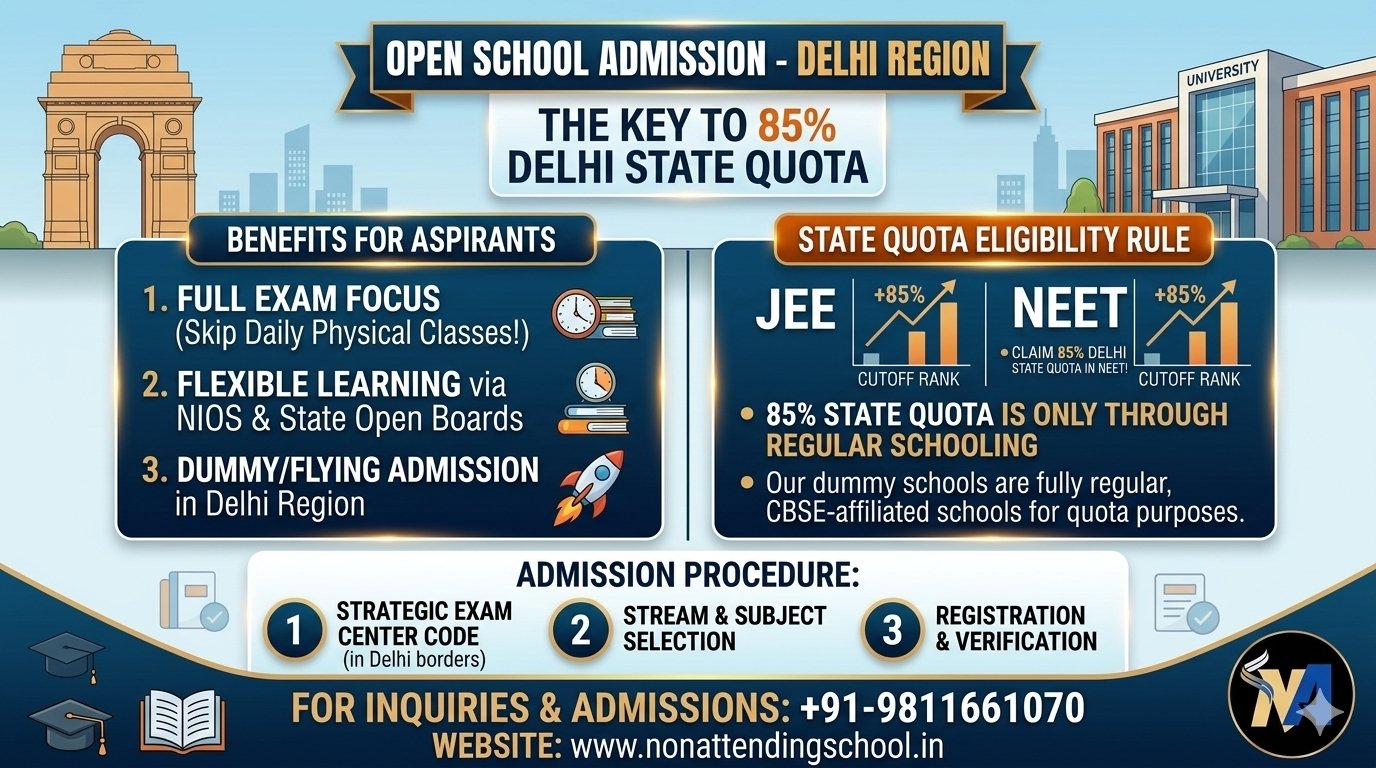
Strategic Guide: Open Schooling Pathways & The Power of the 85% Delhi State Quota for JEE & NEET
Cracking nationwide competitive exams like JEE Main and NEET-UG demands a structural strategy that optimizes your most valuable asset: time. Traditional schooling formats trap engineering and medical aspirants in a daily cycle of 6 to 8 hours of classroom lectures, mandatory attendance regulations, and exhausting school projects. This routine leaves students visually fatigued and limits their self-study windows down to a minimum.
To bridge this massive logistical gap, thousands of high-achieving aspirants are turning to alternative, flexible educational pathways. Choosing an official open schooling framework allows you to substitute daily school attendance with dedicated entrance preparation while legally unlocking game-changing institutional advantages like the legendary 85% state quota of Delhi .
This comprehensive guide explores the core admission procedures for the National Institute of Open Schooling (NIOS) and State Open Boards, details how technical seat allotment occurs, and outlines why establishing your open school credentials in the national capital maximizes your competitive edge.
The Open Schooling Revolution: An Absolute Strategic Choice
For an entrance aspirant, open schooling is no longer just a fallback plan; it is a highly targeted academic maneuver. Registering your senior secondary education (Class XI & XII) through an open board layout delivers the exact operational flexibility found in regular non-attending models.
Students looking for this competitive format often use specific terms during their planning phase:
- Non Attending School in Delhi: Registering through an institutional architecture that fulfills all board guidelines while granting you full freedom from daily physical classes.
- Dummy Admission in Delhi: Structuring your formal academic profile within a localized district to protect crucial study routines and mock exam evaluations.
- Flying Admission in Delhi: Implementing a rapid board registration strategy that immediately frees you from routine attendance roadblocks.
By shifting to an open schooling framework, the board strictly handles your primary examination logging. This leaves you completely unburdened, allowing you to invest your energy directly into cracking national-level entrance modules.
Step-by-Step Admission Procedure: NIOS & State Open Boards
Enrolling in an open schooling system is a highly structured, transparent, and completely digitized procedure. Understanding the structural timelines for both national and state systems ensures your entry remains legally compliant and verified.
1. The National Institute of Open Schooling (NIOS) Procedure
NIOS is an autonomous institution established by the Ministry of Education, Government of India. It stands as the largest open schooling system globally, and its passing certificates are fully accepted by all premium universities, IITs, NITs, and medical counseling boards.
- Streams of Admission: NIOS categorizes its admission intakes into specialized blocks. Stream 1 (Block 1 & Block 2) is designed for fresh candidates aiming to appear for standard public examinations. Stream 2, 3, & 4 are engineered for rapid credit transfers (TOC) or on-demand testing if a student needs to repair past board scores.
- Subject Combination Mapping: To align with national eligibility criteria, competitive aspirants must select their subject groups carefully:
- Engineering Group: Physics, Chemistry, Mathematics, English, and a high-scoring elective (like Data Entry Operations or Computer Science).
- Medical Group: Physics, Chemistry, Biology, English, and a balancing elective.
- Required Documentation: Aspirants must submit scanned, authentic copies of their Class X passing certificate, recent color photographs, signature samples, and a valid identity certificate (such as an Aadhaar Card).
- Setting Your Exam Center Code: To systematically capture the 85% state quota of Delhi , out-of-state students must strategically choose a regional study center and assign their physical examination center code directly within the geographical territory of the NCT of Delhi.
2. State Open School Boards Procedure
State Open Schools operate directly under their respective provincial education ministries. While they follow localized enrollment protocols similar to NIOS, out-of-state students must verify the precise domicile or regional school code guidelines required by each state open board before processing their application file.
Decoding National Seat Allotment Frameworks
To see why an open schooling strategy aligned with a local regional center is highly advantageous, you must map out how seats are distributed nationally during professional university counseling rounds.
The JEE Main / B.Tech Seat Matrix
Technical seat allocation for premium engineering institutes is managed centrally via the Joint Seat Allocation Authority (JoSAA) and the Joint Admission Committee (JAC) Delhi . The seats are divided into two clear segments:
- All India Quota (AIQ): Open seats challenged by millions of applicants nationwide based purely on their raw percentile rank. Cutoffs here are exceptionally tight.
- Home State Quota: A large block of institutional seats reserved exclusively for candidates who passed their qualifying Class XII boards from that specific state.
The NEET-UG / MBBS Seat Matrix
For medical aspirants, the Medical Counselling Committee (MCC) and state-appointed medical directories execute a strict legislative divide:
- 15% All India Quota (AIQ): A minor slice of seats from every government medical college in the country pooled into a single national open merit list.
- 85% State Quota: The remaining 85% of institutional seats within all state-funded medical colleges are completely reserved for local region applicants.
Why the Delhi State Quota Provides an Unmatched Edge
While every state honors its internal state quota, the 85% state quota of Delhi is widely regarded as the most valuable academic asset in India. The national capital features an incredible concentration of the country’s highest-ranked government technical and medical institutions. Let’s evaluate the structural impact across both fields:
The Engineering Paradigm: Delhi State 85% Quota in JEE
Through the JAC Delhi counseling portal, elite institutions like Delhi Technological University (DTU) and Netaji Subhas University of Technology (NSUT) lock up a massive 85% of their total seat matrix exclusively for students from the Delhi region.
The cutoff data reveals an immense structural gap between pools:
- An out-of-state candidate pursuing an open All India seat must clear an exceptionally high percent ranking to win a core technical branch at DTU.
- Conversely, by leveraging the Delhi state quota benefit in JEE , local candidates can comfortably claim high-demand engineering branches with relaxed national ranks—frequently extending into the tens of thousands, and even up to 2 lakhs rank within specific reservation matrices!
The Medical Paradigm: 85% Delhi State Quota in NEET
Delhi houses world-class government medical institutions like Maulana Azad Medical College (MAMC) and Vardhman Mahavir Medical College (VMMC & Safdarjung Hospital) .
Securing entry here through the open All India pool requires a near-flawless score. However, aligning your NIOS or open board examination center code within Delhi automatically unlocks the Delhi state quota in NEET . Under this internal delhi quota in NEET , competition is limited strictly to local regional candidates. This major delhi quota benefit in NEET reduces opening cutoff margins significantly, allowing local students to secure premier government MBBS seats at scores that would instantly disqualify out-of-state applicants.
| System Parameter | All India Quota (AIQ) Path | Delhi State Quota Path (via Local Open Schooling) |
|---|---|---|
| Seat Availability (NEET) | Restricted to 15% of national institutional seats | 85% of all regional seats reserved for local pool |
| Seat Availability (JEE – JAC) | Highly restricted entry for out-of-state profiles | 85% seat reservation across DTU, NSUT, and IIIT-D |
| Competitive Density | Brutal (Millions of applicants nationwide) | Exceptionally low (Only regional board test-takers) |
| DTU / NSUT B.Tech Cutoffs | Closes rapidly at the top tier of national percentiles | Extends smoothly up to tens of thousands (and up to 2 Lakhs in specific categories) |
| MAMC / VMMC MBBS Cutoffs | Requires near-perfect national marks | Offers highly accessible admission via the 85% Delhi state quota in NEET |
Practical Action Plan for Open School Aspirants
To execute this academic strategy successfully, follow this clear roadmap:
- Register Early: Complete your NIOS or open board admission files accurately within the primary Stream 1 entry windows to prevent any unexpected processing delays.
- Verify Regional Codes: Double-check that your formal examination mapping falls securely within an NCT Delhi regional code to establish your structural right to the 85% state quota of Delhi .
- Maintain High Self-Discipline: Treat your open schooling timeline with professional focus. Dedicate your newly gained daytime hours to mock test practice, analytical revision, and resolving core coaching sheets.
- Claim Your Seat Wisely: During the post-entrance phase, submit your applications directly through the JAC Delhi and state medical counseling portals to systematically activate your Delhi state quota benefit in JEE or NEET.
Frequently Asked Questions (Q&A)
Q1: Are NIOS open schooling certificates fully accepted for JEE Main and NEET-UG counseling?
A: Yes, absolutely. NIOS is a national board established by the Government of India. The Medical Counselling Committee (MCC), JoSAA, and JAC Delhi fully recognize NIOS marksheets and certificates, granting open school pass-outs identical status to standard CBSE or ICSE graduates.
Q2: How does an open school profile qualify for the 85% state quota of Delhi?
A: Eligibility for the Home State Quota is determined strictly by the physical location of your designated examination center where you sat for your Class XII board papers. By choosing an examination center code located within the geographical borders of the NCT of Delhi, your open board profile automatically qualifies for the local pool, unlocking the Delhi state quota benefit in JEE and NEET.
Q3: What is the main advantage of using an open board compared to a regular schooling format?
A: A traditional school requires mandatory daily physical attendance, which leaves students exhausted and limits their revision time. An open board option removes these constraints completely, giving you a continuous 8 to 10 hour daily window focused purely on completing coaching assignments, solving tough question banks, and mastering core concepts.
Q4: Can out-of-state engineering aspirants utilize a dummy admission in Delhi to access DTU and NSUT seats?
A: Yes. By processing a strategic dummy admission in Delhi or a flying admission in Delhi via an open schooling center based in the capital, an out-of-state student establishes local exam eligibility. This shift grants them access to the relaxed cutoffs of the Delhi state 85% quota in JEE , making it much easier to secure top engineering branches.
Q5: How does the Delhi state quota benefit in NEET assist medical aspirants with lower ranks?
A: Because Delhi’s government medical colleges are highly prestigious, national competitive cutoffs under the 15% AIQ pool are extremely demanding. The 85% Delhi state quota in NEET builds a protective local barrier. This structural cushion allows local open school candidates to claim premium government MBBS seats even if their marks fall slightly below the absolute national ceiling.
Q6: How are mandatory board practical exams managed in an open schooling system?
A: The open board network allocates a localized reference study center for each student. These centers host short, structured practical orientation sessions and handle your final practical evaluations seamlessly, ensuring your internal board marks card remains competitive and fully compliant.