CBSE, ICSE & State Boards Admission | Non Attending School in Delhi
Apply for a dummy school in Delhi or flying school in Delhi. Get admissions for CBSE, ICSE, IB, UP, Bihar, MP, Haryana & Rajasthan boards to claim the 85% state quota in States!
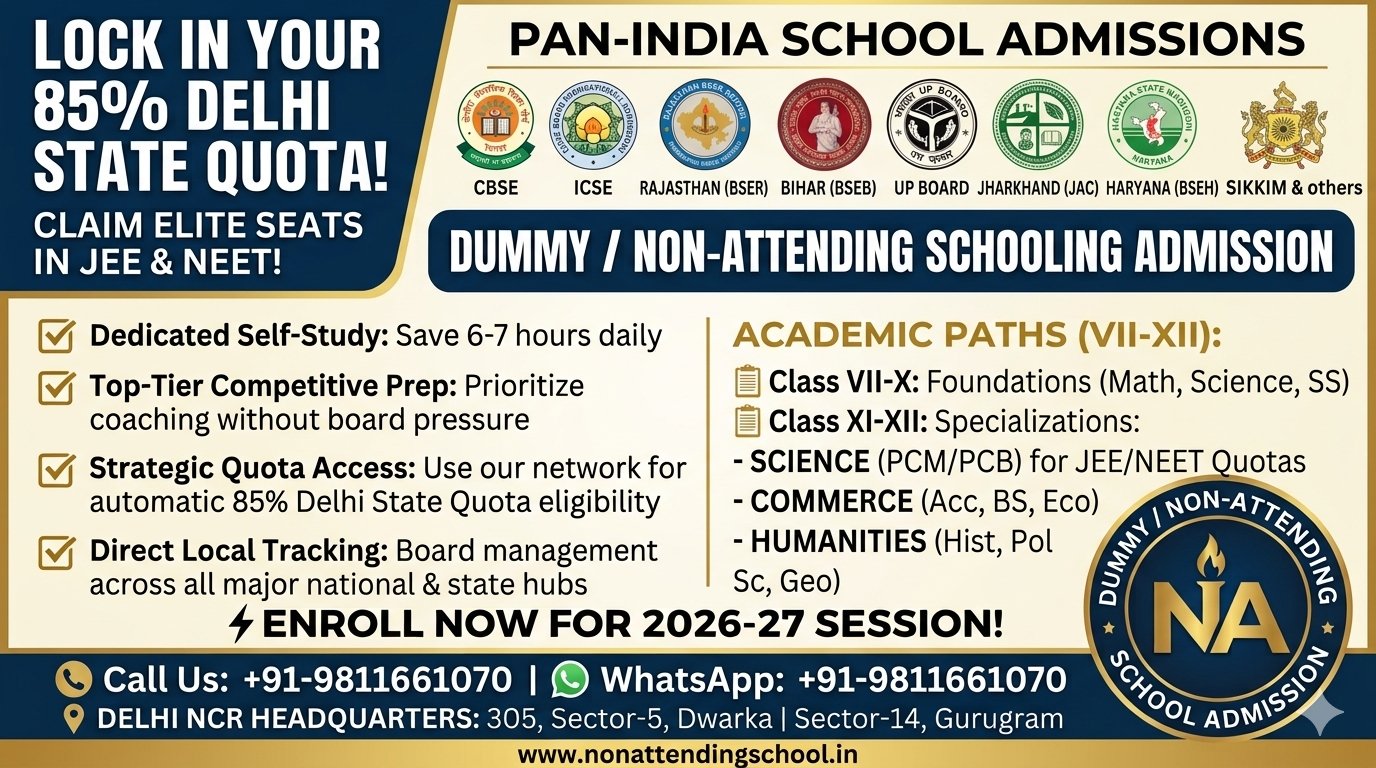
Pan-India School Admissions: CBSE, ICSE, IB and Major State Boards (Rajasthan, Bihar, UP, Jharkhand, Haryana, MP, Chattisgarh and more…)
Welcome to the ultimate pan-India School Admissions Hub at nonattendingschool.in . As India’s top educational integration network, we offer regular schooling tracks alongside flexible, non-attending options across all states. If you are an engineering or medical aspirant preparing for competitive exams like JEE Main, JEE Advanced, and NEET-UG, managing your time between board exam prep and coaching classes is your biggest challenge.
Whether you want to enroll in national boards like CBSE and ICSE or major state educational boards—including Rajasthan (BSER), Bihar (BSEB), Uttar Pradesh (UPMSP), Jharkhand (JAC), Haryana (BSEH), and Sikkim (SBSE) —our network ensures fully accredited, legal registrations while maximizing your self-study hours. This guide details our academic curriculum for Middle School (Classes VII–VIII), Secondary School (Classes IX–X), and Senior Secondary Streams (Classes XI–XII) across India, while explaining how to use your board registration to secure valuable institutional quotas.
1. The Strategy: National & State Boards vs. Flexible Schooling
India’s primary national and state boards provide strong academic foundations, but their strict rules often create challenges for competitive coaching schedules:
- The Time Bottleneck: Standard board affiliations enforce rigid daily attendance rules, typically requiring a 75% physical presence in the classroom. When you add standard school hours to a 4-to-5-hour competitive coaching routine, you are left with zero time for daily self-study and revision.
- The Flexible Resolution: Our platform connects you with verified Non attending schools in India . By choosing this path, you remain fully compliant with board guidelines, sit for all mandatory final board examinations, and save 6 to 7 hours daily for dedicated mock testing and problem-solving. This balanced approach is highly popular across the country, especially for families seeking options like a non attending school from Bihar or a traditional Dummy school from Kota (Rajasthan) .
2. Unlocking the 85% Delhi State Quota Advantage
The most valuable tactical advantage we provide to students across India is the ability to claim the highly coveted institutional reservations in the national capital through Non attending schooling from Delhi .
Many families do not know that under current centralized entrance admission guidelines, eligibility for regional state reservation quotas is determined solely by the geographical location of the school where the candidate clears their Class XI and Class XII board examinations . Domicile certificates, parental land records, or native state roots do not alter this specific rule.
            HOW GEOGRAPHIC BOARD CODES UNLOCK ELITE SEATS
+-----------------------------------------------------------------------+
|  Native Student Base: Rajasthan / Bihar / UP / Jharkhand / Haryana    |
+-----------------------------------------------------------------------+
                                    │
                                    ▼
+-----------------------------------------------------------------------+
|  Strategic Registration via Platform: Non attending school in Delhi   |
+-----------------------------------------------------------------------+
                                    │
                                    ▼
+-----------------------------------------------------------------------+
|  Automatic Eligibility Approved: 85% Regional State Quota in Delhi    |
+-----------------------------------------------------------------------+
Complete Breakdown of the Delhi State Reservation Advantage
By using our network to register under an accredited Dummy school in Delhi or a specialized Flying school in Delhi , you position your academic records inside the national capital pool. This grants you direct eligibility for the highly valuable 85% state quota in Delhi institutional allocations.
Learning exactly how 85% Delhi state quota availed metrics work can fundamentally change your competitive entrance outcomes:
- Engineering Aspirants: You can Secure your B. Tech government seat through 85% delhi state quota at elite technical universities like Delhi Technological University (DTU) and Netaji Subhas University of Technology (NSUT). Under the 85% Delhi quota in JEE main , regional quota cutoffs are significantly more accessible, allowing local candidates to claim core branches at ranks that would be out of bounds under the All India Quota (AIQ) allocations.
- Medical Aspirants: You can secure your MBBS government seat through 85% delhi state quota at premier medical colleges, including Maulana Azad Medical College (MAMC), Vardhman Mahavir Medical College (VMMC), and University College of Medical Sciences (UCMS). Utilizing the 85% state quota in NEET moves you into a smaller, regional pool of competitors, lowering the score thresholds required for selection.
Understanding how to get 85% delhi state quota in JEE and NEET enables students from any state board, CBSE, or ICSE school across India to legally claim the benefits of the Delhi state 85% quota in JEE / NEET-ug while using their flexible study schedules to maximize their entrance scores.
3. Overview of Major Educational Boards Across India
Our platform streamlines your admissions across multiple national and regional boards, matching curriculum requirements with optimized schedules.
CBSE (Central Board of Secondary Education) & ICSE
As India’s premier national boards, CBSE and ICSE provide a comprehensive syllabus that aligns well with competitive exams. We help students across the country register with flexible CBSE and ICSE institutions, allowing them to balance their board scores with entrance preparation.
Rajasthan Board of Secondary Education (BSER / RBSE)
Operating primarily through our counseling frameworks in Kota, Sikar, and Alwar, we match BSER curriculum requirements with flexible schedules. This pathway allows students to stay near their physical coaching hubs while maintaining smooth board compliance.
Bihar School Examination Board (BSEB)
For students in Patna, Darbhanga, and Madhubani, our network provides direct coordination for BSEB registrations. This saves families from unnecessary relocation expenses and lets students complete their secondary or senior secondary cycles under their home state board without the stress of rigid daily attendance checks.
Uttar Pradesh Madhyamik Shiksha Parishad (UPMSP)
UPMSP is one of the largest board structures in the world. We assist students throughout Uttar Pradesh in navigating their academic registrations cleanly, providing flexible pathways that free up essential daytime hours for competitive preparation.
Jharkhand Academic Council (JAC) & Haryana (BSEH)
Serving students across Ranchi, Dhanbad, Rohtak, and Gurugram, our JAC and BSEH coordination models help science and commerce students align their state board preparations with parallel entrance exam targets.
Sikkim Board of Secondary Education (SBSE) & Beyond
Our network extends to eastern jurisdictions and other states across India, providing uniform support for regional board registrations while keeping your core study hours highly flexible.
4. Academic Details: Middle School (Classes VII and VIII)
Our Middle School academic track focuses on building analytical clarity, structural logic, and foundational core principles. This balanced curriculum framework applies to both our full-time regular tracks and our flexible non-attending models.
Mathematics
- Advanced Arithmetic: Systematic analysis of rational numbers, fractions, decimal conversions, exponents, scientific notations, square roots, and cube roots.
- Commercial Applications: Practical problem-solving involving ratios, proportions, percentages, profit and loss calculations, and simple/compound interest formulas.
- Algebraic Concepts: Comprehensive grounding in algebraic expressions, variables, coefficients, linear equations in one variable, and basic algebraic identities.
- Geometry & Mensuration: Core geometric properties of lines, parallel intersections, angles, triangles, and quadrilaterals, along with perimeter, area, and volume calculations for basic 2D and 3D shapes.
Integrated Natural Sciences
- Physics: Introductory models covering motion mechanics, distance metrics, light behaviors, shadows, reflections, fundamental electric circuits, and magnetic properties.
- Chemistry: Comprehensive analysis of natural vs. synthetic fabrics, sorting materials, separation of mixtures, and physical vs. chemical changes in daily environments.
- Biology: Deep dive into food groups, nutritional tracking, plant structures, human skeletal movements, and living organism adaptation matrices.
5. Academic Details: Secondary School (Classes IX and X)
Classes IX and X form the crucial foundation for senior secondary board performance and align with the core patterns of national aptitude tests.
                     SECONDARY BOARD SYLLABUS LAYOUT
+-----------------------+-----------------------+-----------------------+
|      MATHEMATICS      |   NATURAL SCIENCES    |    SOCIAL SCIENCES    |
+-----------------------+-----------------------+-----------------------
| • Advanced Polynomials| • Physics Mechanics   | • National Histories  |
| • Trigonometry Basics | • Chemistry Equations | • Economic Sectors    |
| • Coordinate Geometry | • Cellular Organelles | • Resource Mapping    |
| • Frequency Mapping   | • Practical Lab Logs  | • Constitutional Civ. |
+-----------------------+-----------------------+-----------------------+
Advanced Mathematics Matrix
- Algebraic Core: Real numbers, polynomial theorems, factorizations, linear equations in two variables, quadratic functions, and arithmetic progressions (AP).
- Trigonometry & Spatial Geometry: Structural properties of triangles, circle proofs, coordinate layouts, introduction to trigonometric ratios, standard identities, and applications in heights and distances.
- Statistics & Data Tracking: Grouped frequency distributions, cumulative frequency graphs, mean/median/mode calculations, and theoretical probability distributions.
Science Grid (Physics, Chemistry, Biology)
- Physics: Complete mathematical study of motion, force laws, gravitation, work, power parameters, energy transformations, sound wave properties, light reflection/refraction, lens formulas, human eye optics, current electricity, Ohm’s law, and magnetic fields.
- Chemistry: Matter variations, atomic models, chemical formulas, structural equations, types of reactions, acids, bases, salts, metallurgy indicators, and carbon compounds.
- Biology: Deep dive into basic cellular units, plant/animal tissues, key life processes (nutrition, respiration, circulation, excretion), control systems, and introductory genetics.
6. Senior Secondary Matrix: Classes XI & XII Stream Specializations
The final two years require deep stream-specific focus. Our academic setup bridges state board syllabi with competitive test patterns across all three major streams.
Stream A: The Science Stream (PCM / PCB)
Optimized for engineering and medical aspirants looking to maximize their performance under the Delhi state 85% quota in JEE / NEET-ug .
1. Physics
- Class XI Core: Mathematical tools, kinematics, laws of motion, work-energy theorems, rotational dynamics, gravitation, bulk matter properties, thermodynamics, kinetic theory of gases, and waves.
- Class XII Core: Electrostatics, capacitance, current electricity, magnetic effects of current, electromagnetic induction (EMI), alternating currents (AC), electromagnetic waves, ray/wave optics, dual nature of matter, atomic physics, and semiconductor electronics.
2. Chemistry
- Class XI Core: Basic chemical concepts, atomic structure, periodic trends, chemical bonding, thermodynamics, equilibrium systems, redox reactions, and hydrocarbons.
- Class XII Core: Solutions, electrochemistry, chemical kinetics, d-block/f-block elements, coordination compounds, haloalkanes, alcohols, phenols, ethers, aldehydes, ketones, carboxylic acids, amines, and biomolecules.
3. Mathematics
- Class XI Core: Sets, relations, functions, trigonometric functions, mathematical induction, complex numbers, permutations, combinations, binomial theorem, sequences, and conic sections.
- Class XII Core: Inverse trigonometric equations, matrices, determinants, calculus (continuity, differentiability, applications of derivatives, integration, differential equations), vectors, 3D geometry, and probability.
4. Biology
- Class XI Core: Living diversity, plant/animal structural organization, cell biology, plant physiology, and human physiology modules.
- Class XII Core: Plant/human reproduction, inheritance principles, molecular genetics, evolutionary models, biology in human welfare, biotechnology, and ecology.
Stream B: The Commerce Stream
Our Commerce curriculum builds a strong foundation in corporate financial systems, organizational theory, macro-fiscal dynamics, and market economics.
1. Accountancy
- Class XI Core: Double-entry bookkeeping, journal entries, ledger accounts, trial balances, bank reconciliations, depreciation accounting, and final financial records for sole proprietorships.
- Class XII Core: Accounting for partnerships (admissions, retirements, dissolutions), company accounts (issue and forfeiture of shares, debentures), financial statement analysis, accounting ratios, and cash flow analysis.
2. Business Studies
- Class XI Core: Foundations of business, forms of business organizations, public/private/global enterprises, business services, and business ethics.
- Class XII Core: Principles of management, planning, organizing, staffing, directing, controlling, financial management, financial markets, marketing management, and consumer protection.
3. Economics
- Class XI Core: Statistics for Economics (data handling, central tendency, dispersion, index numbers) paired with introductory Microeconomics (consumer demand, production functions, cost concepts, market forms).
- Class XII Core: Macroeconomics (national income accounting, banking, income determination, government budgets) and Indian Economic Development histories.
Stream C: The Humanities / Arts Stream
The Humanities track offers a thorough exploration of human history, political systems, and spatial geography, designed for civil services, law, and research aspirants.
1. History
- Class XI Core (Themes in World History): Focuses on early societies, nomadic empires, cultural encounters, the Industrial Revolution, and paths to modernization.
- Class XII Core (Themes in Indian History): Covers Ancient India (Harappan urban designs), Medieval India (travelers’ records, Bhakti-Sufi movements), and Modern India (colonialism, national independence movements, framing of the Constitution).
2. Political Science
- Class XI Core: The Indian Constitution at Work (fundamental rights, directive principles, executive, legislature, judiciary) and Political Theory (freedom, equality, social justice, rights).
- Class XII Core: Contemporary World Politics (multipolar transitions, international organizations, globalization) and Politics in India Since Independence (nation-building, foreign policy, coalition eras).
3. Geography
- Class XI Core: Fundamentals of Physical Geography (Earth’s interior, geomorphic processes, climate regimes) and India: Physical Environment (physiography, drainage networks).
- Class XII Core: Fundamentals of Human Geography (global population trends, economic activities, international trade) and India: People and Economy (resource allocations, sustainable planning).
7. Comparative Streams Overview: A Scannable Roadmap
To assist parents and students in choosing the right path for their upper-secondary years, the table below compares the distinct focus areas and career alignments of each stream:
| Feature / Metric | Science Stream (PCM / PCB) | Commerce Stream | Humanities / Arts Stream |
|---|---|---|---|
| Primary Academic Focus | Empirical analysis, quantitative math, life systems, spatial tracking | Corporate financial structures, market economics, organizational logic | Historical timelines, governance models, human geography, social philosophy |
| Core Compulsory Subjects | Physics, Chemistry, Mathematics / Biology, English | Accountancy, Business Studies, Economics, English | History, Political Science, Geography, English |
| Target Entrance Alignments | JEE Main, JEE Advanced, NEET-UG, CUET, NDA | CA Foundation, CS, CMA, IPMAT, CUET, CLAT | UPSC Civil Services, CLAT, Liberal Arts Entrances, CUET |
8. Admissions and Onboarding Process for All Boards
Enrolling through our national school admissions network is simple, clear, and fully supportive.
- Phase 1 (Strategy Mapping): Connect with our academic counselors to map out your career goals. We help you choose between local board paths or a strategic registration under a non attending school in Delhi to secure high-value regional quota benefits.
- Phase 2 (Administrative Onboarding): Our team manages the paperwork. We collect previous school leaving certificates (SLC), academic records, and identity proofs, ensuring full compliance with board registration guidelines.
- Phase 3 (Preparation Mode): Once your enrollment is secured, your day-to-day schedule is flexible. You can focus fully on your competitive coaching classes and self-study, while our platform tracks all your necessary board schedules, practical exams, and admit card distributions.
Balance your board requirements with your competitive preparation goals. Visit nonattendingschool.in to secure your academic path and lock in your long-term institutional advantages today.