Non Attending School in Delhi | Secure 85% State Quota of Delhi
Looking for a Non attending / Dummy admission in Delhi or flying admission in Delhi? Maximize your self-study time and lock in your 85% Delhi state quota in NEET and Delhi state quota benefit in JEE to easily claim premium government college seats. Learn how it works!

Complete Overview of Non-Attending Schooling: Cracking JEE Main & NEET-UG with the Power of the 85% Delhi State Quota
Stepping into the competitive arena of national engineering and medical entrances requires more than just hard work—it demands structural strategy. Every year, lakhs of aspirants across India target a coveted seat in elite institutions through JEE Main and NEET-UG . However, managing a grueling 6-hour daily routine at a traditional school alongside intense coaching schedules often leads to extreme student burnout, low self-study yields, and diminished performance.
To bridge this gap, strategic aspirants leverage alternative educational paths that prioritize self-study while legally maximizing institutional benefits. This definitive guide explores how utilizing a non attending school in Delhi protects your preparation time and unlocks unparalleled systemic advantages like the legendary 85% state quota of Delhi .
Understanding the Landscape: The Rise of Non-Attending Schooling
For an engineering or medical aspirant, time is the ultimate currency. A standard regular schooling path forces a student to dedicate 6 to 8 hours daily to mandatory classroom lectures, assemblies, physical education, non-academic school events, and complex project portfolios. When combined with an additional 4 to 5 hours of specialized coaching classes, students routinely face 13 to 14 hour workdays just sitting in classrooms. This leaves zero time for the three pillars of competitive success: conceptual revision, rigorous practice, and exhaustive mock test evaluation.
This logistical nightmare has driven the widespread adoption of specialized schooling formats designed around the needs of aspirants:
- Non Attending Schooling: A legal alignment where a student is formally registered with an affiliated regular school but is granted exemption from day-to-day physical attendance. The school strictly handles all regulatory requirements, internal logging, board documentation, and formal registrations, allowing the student to stay home or attend dedicated coaching centers full-time.
- Dummy Admission in Delhi: The framework where students transfer their board registration to specific institutions in the National Capital Territory (NCT) of Delhi. This allows them to focus purely on entrance exams while automatically establishing vital local residency credentials for board evaluation purposes.
- Flying Admission in Delhi: An identical strategic term used for rapid structural enrollment in board-recognized schools where minimal classroom intervention is required, accelerating the student’s transition into full-time competitive preparation tracks.
Decoding the Admission and Seat Allotment Frameworks
To appreciate why a dummy admission in Delhi or a structured flying admission in Delhi is so powerful, it is essential to first trace how seats are allocated at the national level for engineering and medical courses.
1. The JEE Main & Advanced B.Tech Allocation Model
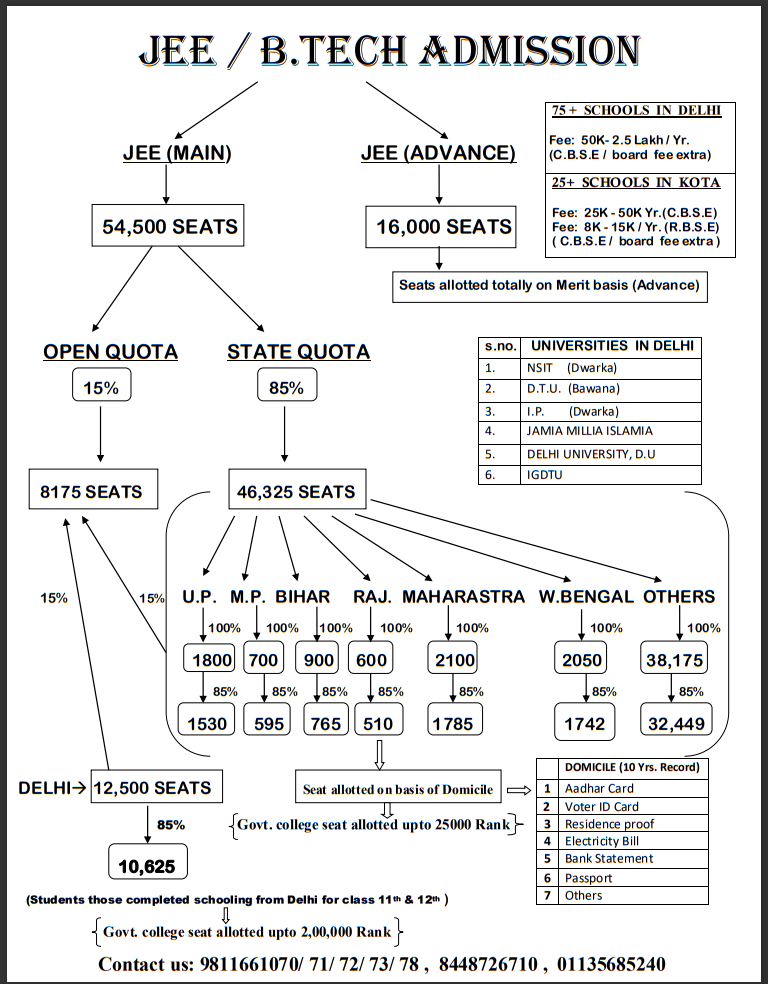
The Joint Entrance Examination (JEE) opens the doors to premier engineering colleges across the country. The allocation of seats is managed centrally by bodies like the Joint Seat Allocation Authority (JoSAA) and the Central Seat Allocation Board (CSAB) for national institutes (IITs, NITs, IIITs), alongside the Joint Admission Committee (JAC) Delhi for Delhi’s elite state universities (DTU, NSUT, IGDTUW, IIITD).
The seat matrix is structurally bifurcated into two foundational pools:
- All India Quota (AIQ): Open to every single student across India strictly based on their raw All India Rank (AIR). Competition here is exceptionally fierce, as hundreds of thousands battle for a handful of seats.
- Home State Quota: A reserved segment within state-funded or state-aligned institutions dedicated exclusively to students who have completed their qualifying board examinations (Class 11 and 12) within that specific geographic territory.
2. The NEET-UG MBBS/BDS Allocation Model
For medical aspirants, the National Eligibility cum Entrance Test (NEET-UG) dictates entry into all government and private medical colleges nationwide. The seat matrix follows a strict legislative divide managed by the Medical Counselling Committee (MCC) and respective state counseling authorities:
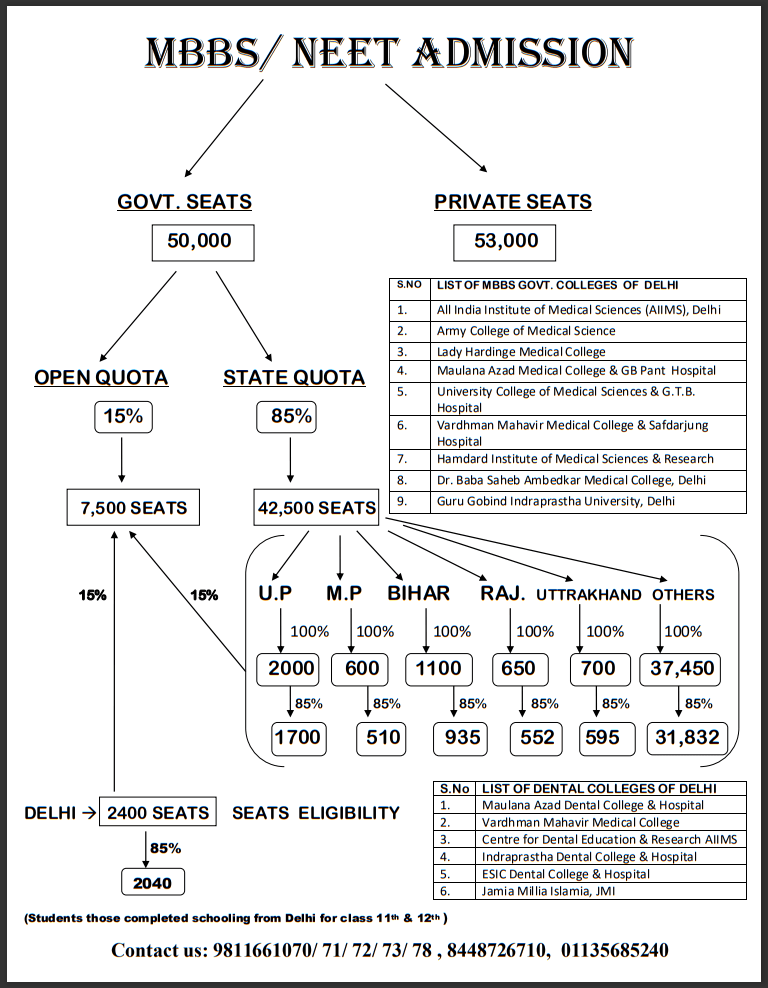
- 15% All India Quota (AIQ): 15% of all available seats in every single government medical college across India are pooled into a single open merit list. Any student from any state can claim these seats based on their national NEET rank.
- 85% State Quota: The remaining 85% of seats within all government medical colleges are walled off by state legislation. These seats are accessible only to candidates who satisfy the specific regional eligibility rules of that particular state.
The Core Metric: Why the State Quota Strategy is Essential
The entry barrier to government medical and engineering colleges via the All India Quota is notoriously high. In NEET-UG, a difference of even a single mark can swing a student’s national rank by thousands of positions, frequently pushing students out of the government MBBS pool entirely. Similarly, in JEE Main, securing a core branch like Computer Science Engineering (CSE) at a top-tier national institute under the open All India pool requires an incredibly high percentile.
This is where the Home State Quota completely transforms your odds. By shielding a massive percentage of institutional seats (up to 85%) from the general nationwide pool, the state quota drops the competitive density drastically. You are no longer competing against 24 lakh students across the subcontinent; you are only competing against the subset of students who registered for their board exams within your specific state boundaries. Consequently, cutoffs drop significantly, enabling students with modest state ranks to claim premium government seats that would be completely out of reach on the All India open merit lists.
The Ultimate Advantage: The Power of the Delhi State Quota
While every state features a regional quota, the 85% state quota of Delhi stands as the single most lucrative academic asset in the nation. The NCT of Delhi hosts an extraordinary concentration of India’s highest-ranked, globally renowned government engineering and medical institutions.
By ensuring your Class 11 and 12 enrollment goes through a recognized non attending school in Delhi , you automatically unlock the massive delhi quota in NEET and the Delhi quota in JEE . Let’s break down the immense real-world impact across both professional domains:
The Engineering Paradigm: Delhi State 85% Quota in JEE
Delhi is home to elite technical state universities that rival the older IITs in terms of corporate placement, campus infrastructure, research output, and alumni network. Through the Joint Admission Committee (JAC) Delhi counseling process, institutions like Delhi Technological University (DTU) , Netaji Subhas University of Technology (NSUT) , and Indira Gandhi Delhi Technical University for Women (IGDTUW) set aside 85% of their vast seat matrix exclusively for students from the Delhi region.
The data highlights a massive structural variance:
- All India Pool vs. Delhi Pool Cutoffs: For an out-of-state student trying to get into DTU or NSUT via the All India quota, the rank cutoffs are extremely unforgiving—often closing within the top few thousands for premier engineering branches.
- The State Quota Reality: Thanks to the Delhi state quota benefit in JEE , local Delhi school pass-outs can comfortably secure highly coveted engineering branches at DTU or NSUT even with ranks extending deep into the tens of thousands—and in various reserved or specialized categories, up to 2 lakhs rank!
This drastic cushion means that an engineering aspirant utilizing a non attending school in Delhi secures a massive safety net. If a bad exam day impacts your national ranking slightly, the Delhi state 85% quota in JEE keeps the doors to India’s highest-placing technical universities wide open.
The Medical Paradigm: 85% Delhi State Quota in NEET
The medical seat landscape in Delhi is the gold standard of Indian medical education. Institutions like Maulana Azad Medical College (MAMC) , Vardhman Mahavir Medical College (VMMC & Safdarjung Hospital) , and Lady Hardinge Medical College (LHMC) are universally recognized for offering unparalleled clinical exposure, low fees, and prestigious central residency opportunities.
Securing an MBBS seat here through the 15% All India Quota requires a near-flawless score, often demanding a rank within the top few hundred nationwide. However, the 85% Delhi state quota in NEET entirely rewrites these rules. By evaluating candidates through the internal Delhi state quota in NEET , the qualifying rank requirements drop substantially compared to the brutal AIQ cutoffs.
This specific Delhi qtaate quota benefit in NEET gives local aspirants a profound edge: they can drop several points below the absolute national ceiling and still comfortably walk away with an MBBS seat at a premier central government college in the capital city.
| Feature / Quota Parameter | All India Quota (AIQ) Pool | Delhi State Quota Pool (Via Delhi Schooling) |
|---|---|---|
| Seat Distribution (NEET) | Only 15% of seats open to nationwide pool | 85% of all regional institutional seats locked for local pool |
| Seat Distribution (JEE – JAC) | Minimal seat percentage for out-of-state entries | 85% reservation across DTU, NSUT, and IGDTUW |
| Competitive Density | High (Millions of candidates nationwide) | Low (Only candidates registered via Delhi Board schools) |
| DTU / NSUT B.Tech Cutoffs | Closes rapidly at highly competitive national ranks | Extends smoothly up to tens of thousands (and up to 2 Lakhs rank in specific categories) |
| MAMC / VMMC MBBS Cutoffs | Demands near-flawless national ranks | Offers relaxed ranks via the Delhi state quota benefit in NEET |
Tactical Execution: Balancing Merits and Practical Realities
Transitioning to a non attending school in Delhi is an excellent structural strategy, but it must be executed with careful planning and a highly disciplined approach.
Maximizing the Academic Merits
- Elimination of Daily Fatigue: By removing a grueling 6-hour daily routine at a regular school, you eliminate physical exhaustion, long commutes, and mandatory non-academic workloads.
- Uninterrupted Self-Study Windows: Students gain a massive 8 to 10 hour daily window dedicated entirely to core competitive revision, syllabus tracking, resolving personal conceptual gaps, and practicing multi-tiered question banks.
- Strategic Focus Alignment: There is zero friction between balancing standard school homework assignments, internal project documentation, and competitive mock series. Your entire curriculum aligns perfectly with the depth required for cracking national levels.
Navigating the Practical Considerations
- The Self-Discipline Imperative: The absolute absence of a strict everyday school bell means the student bears total responsibility for their daily schedule. Without an organized routine, a non-attending format can quickly lead to procrastination. To combat this, ensure you mirror a highly structured coaching timeline.
- Verifying Board Affiliation: It is critical to ensure that the dummy school framework you choose is fully recognized and compliant with central boards like the CBSE. Authoritative educational partners ensure that all formal student tracking numbers, internal marks, and practical exam schedules are managed seamlessly and legally, keeping your board credentials pristine.
Step-by-Step Strategic Action Plan for Aspirants
If your ultimate academic goal is to secure a government seat in a top-tier B.Tech or MBBS college in Delhi, your execution roadmap should follow this structural path:
- Secure Timely Enrollment: Ensure your registration in a recognized non attending school in Delhi is processed smoothly during the critical transition windows for Class 11 or early Class 12.
- Establish Clear Regional Tracking: Confirm that your formal examination center and board registration fall strictly within the NCT Delhi regional codes. This registration serves as the legal foundation for claiming the 85% state quota of Delhi during JoSAA/JAC and MCC counseling rounds.
- Build a Dedicated Routine: Treat your home study environment or coaching center as your full-time operational base. Design an intense, rigorous routine that dedicates major blocks of time to problem-solving, formula active recall, and full-length simulated mock testing.
- Execute the Counseling Phase Wisely: Once your JEE Main or NEET-UG results are out, apply directly through the specific regional portals (JAC Delhi for engineering; MCC/IP University portals for medical seats) to systematically invoke your Delhi state quota benefit in JEE or NEET to secure your premier institutional placement.
Frequently Asked Questions (Q&A)
Q1: What exactly is a non attending school in Delhi, and is it recognized by national boards?
A: A non-attending school operates as an affiliated regular educational institution that formally registers a student with boards like the CBSE, fulfills all required official documentation, but exempts the student from day-to-day physical classroom attendance. This allows the student to dedicate their full time to specialized competitive exam coaching and intensive self-study while their formal board registration remains fully active and recognized.
Q2: How does a dummy admission in Delhi help me qualify for the Delhi state 85% quota in JEE?
A: The eligibility rule for the Home State Quota under JAC Delhi (which governs admissions to DTU, NSUT, and IIITD) states that a candidate must have passed their qualifying examination (Class 12 or equivalent) from a school located within the National Capital Territory (NCT) of Delhi. By securing a dummy admission in Delhi , your formal board certificate lists a Delhi region school, automatically making you eligible for the massive Delhi state 85% quota in JEE .
Q3: Can a student from outside Delhi claim the 85% Delhi state quota in NEET by using a flying admission in Delhi?
A: Yes. Eligibility for the institutional Delhi quota under university bodies like Guru Gobind Singh Indraprastha University (GGSIPU) and Delhi University (DU) for MBBS seats depends entirely on where you completed your Class 11 and 12 schooling. If you utilize a flying admission in Delhi to complete your senior secondary board registration within a Delhi-based school, you satisfy the physical criteria to claim the highly advantageous delhi quota in NEET .
Q4: What is the primary difference between the All India Quota and the Home State Quota during seat allotment?
A: The All India Quota pools candidates from across the entire country into a single high-stakes merit list based purely on nationwide rank, offering limited seats. The Home State Quota sets aside up to 85% of an institution’s seat matrix exclusively for local region candidates. This dramatically narrows down the competitive pool, leading to significantly lower cutoffs and a much higher chance of securing a government seat.
Q5: Is it true that a student can get into DTU or NSUT at a rank up to 2 lakhs via the Delhi state quota benefit in JEE?
A: Yes, depending on the category (such as SC, ST, OBC, EWS, or defense sub-categories) and specialized engineering branches, the closing ranks for Delhi region candidates under the Delhi state quota benefit in JEE routinely extend into tens of thousands, and frequently up to 2 lakhs or lower. This stands in stark contrast to the All India open pool, which closes at exceptionally rigid ranks for out-of-state candidates.
Q6: How does the Delhi qtaate quota benefit in NEET assist medical aspirants with lower ranks?
A: Because Delhi government medical colleges are highly prestigious, the national cutoffs under the 15% All India Quota are extremely tight. The regional 85% Delhi state quota in NEET creates a protected pool for local school pass-outs. This buffer allows local candidates to secure a coveted MBBS seat at premium institutions like MAMC or VMMC even if their marks fall slightly below the absolute national cutoffs.
Q7: Does opting for a non-attending format impact a student’s preparation for board practical exams?
A: Not at all. Recognized non-attending schools systematically coordinate with students regarding mandatory board timelines, structural internal assignments, and formal practical examination schedules. This ensures that while you skip everyday classes, you remain fully updated, prepared, and compliant for your final board practical and theory evaluations.